01 Introduction
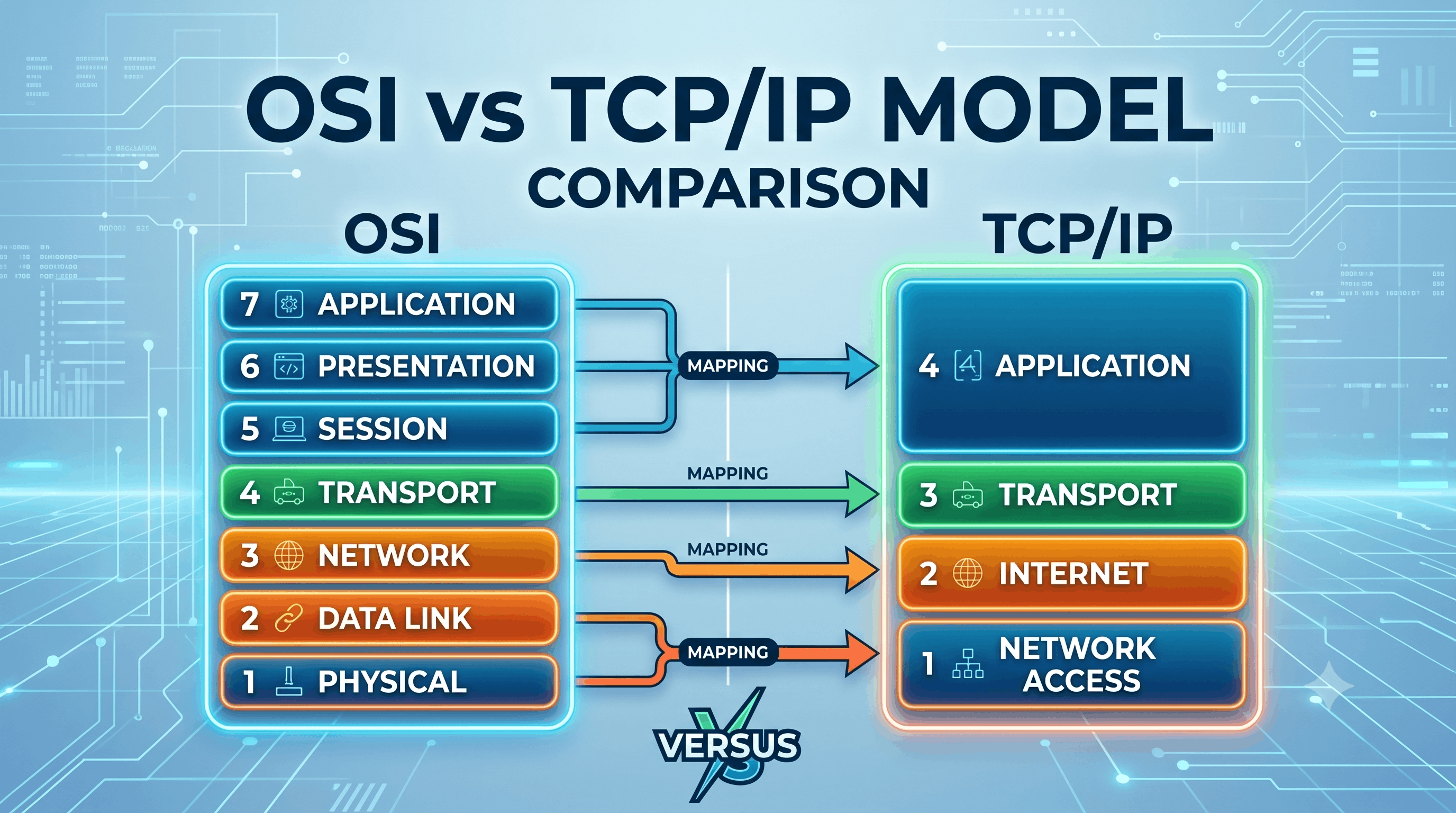
Before you can troubleshoot a network outage, design a secure architecture, or write a TCP socket server, you need to understand how networking is organised conceptually. Two models define this organisation:
- OSI Model – Open Systems Interconnection, a 7-layer theoretical framework by ISO (1984)
- TCP/IP Model – the 4-layer practical model that powers the modern Internet
Both models describe the same physical reality. Think of OSI as a detailed anatomy textbook and TCP/IP as the working body. Doctors study both.
💡 Key Insight
OSI is used for teaching and troubleshooting. TCP/IP is what your computer actually implements. Master both network certifications (CCNA, CompTIA Network+) test you on OSI; production code uses TCP/IP.
02 The OSI Model – 7 Layers
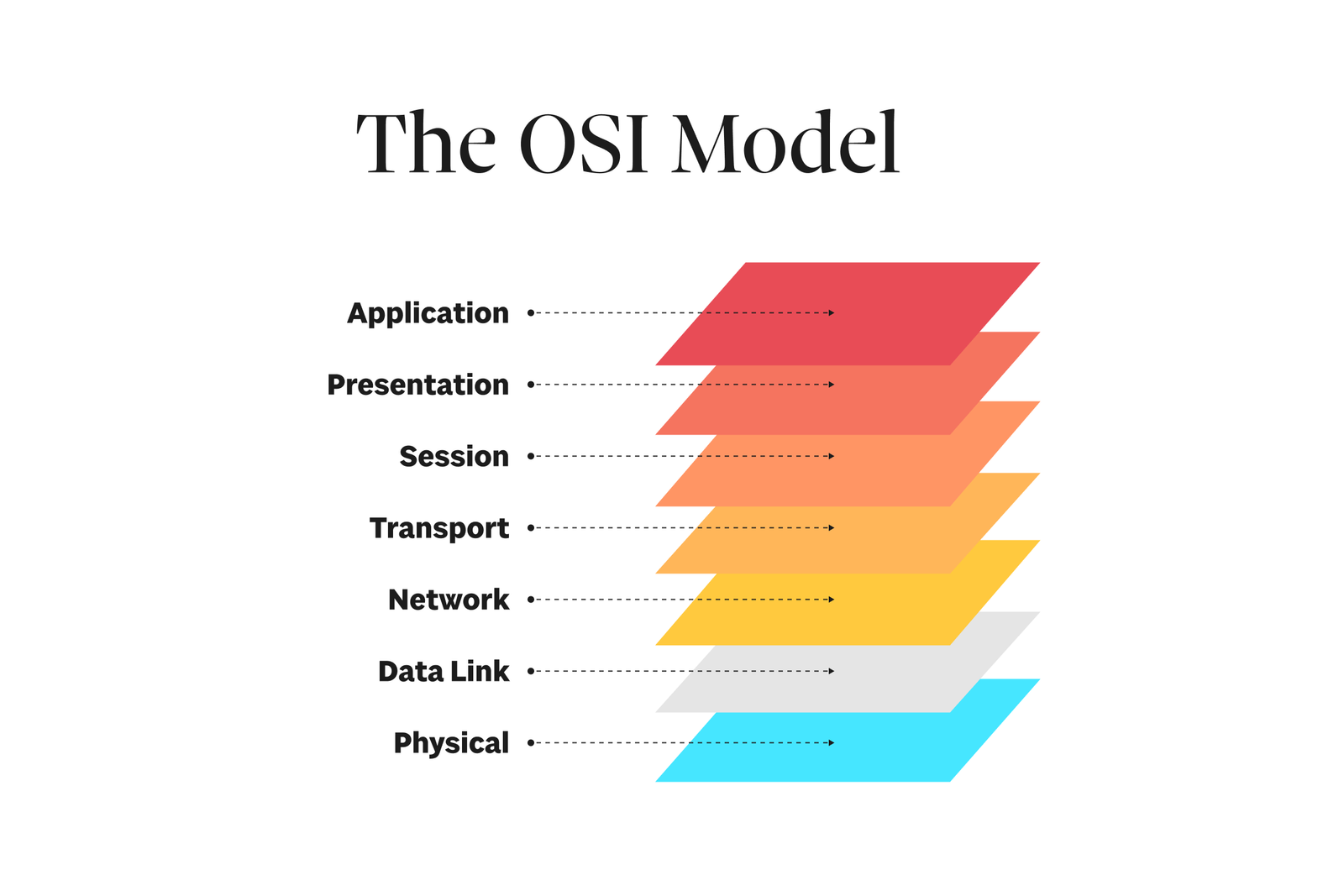
The OSI model breaks networking into 7 distinct, independent layers. Each layer only communicates with the layers directly above and below it. The classic mnemonic: "Please Do Not Throw Sausage Pizza Away" (Physical → Data Link → Network → Transport → Session → Presentation → Application).
Layer 7 – Application
Closest to the user. Provides network services directly to applications. Protocols: HTTP, HTTPS, FTP, SMTP, DNS, SNMP.
Layer 6 – Presentation
Translates data between the network and application. Handles encryption, compression, and encoding (SSL/TLS lives here in the OSI view). Formats: JPEG, MPEG, ASCII.
Layer 5 – Session
Manages sessions (connections) between applications. Establishes, maintains, and terminates dialogues. Examples: NetBIOS, PPTP, SQL sessions.
Layer 4 – Transport
End-to-end communication. Provides reliable delivery (TCP) or fast, best-effort delivery (UDP). Segmentation, flow control, error recovery.
Layer 3 – Network
Logical addressing and routing. IP addresses live here. Routers operate at this layer. Protocols: IP, ICMP, ARP (debated), OSPF, BGP.
Layer 2 – Data Link
Node-to-node delivery. Uses MAC addresses. Divided into LLC (Logical Link Control) and MAC sublayers. Switches operate here. Protocols: Ethernet, Wi-Fi (802.11), PPP.
Layer 1 – Physical
Raw bits over physical media — electrical signals, light pulses, radio waves. Defines cables, hubs, repeaters, and connector types (RJ45, fibre optic).
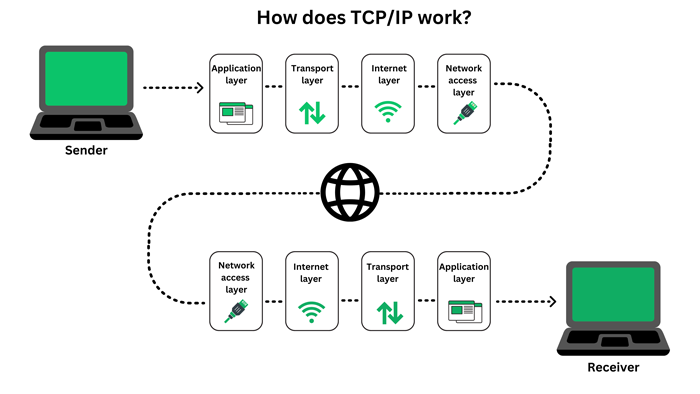
03 The TCP/IP Model – 4 Layers
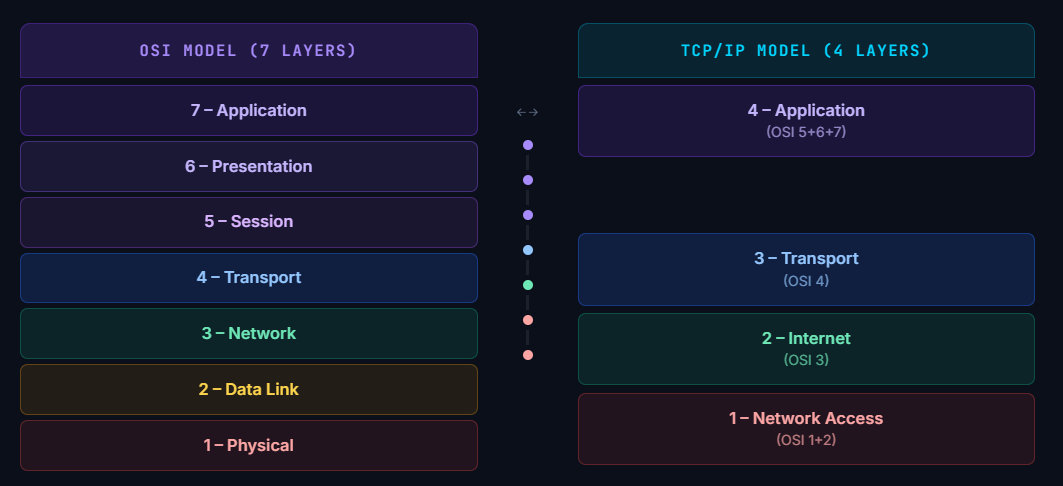
Born from ARPANET research, the TCP/IP model is what the Internet actually uses. It collapses OSI's 7 layers into 4 pragmatic layers.
Layer 4 – Application
Combines OSI layers 5, 6, and 7. Everything user-facing: HTTP/S, DNS, FTP, SMTP, SSH, Telnet.
Layer 3 – Transport
Maps directly to OSI Layer 4. TCP (reliable, connection-oriented) and UDP (fast, connectionless).
Layer 2 – Internet
Maps to OSI Layer 3. IP addressing and routing. Core protocol is IP (v4 and v6), plus ICMP and IGMP.
Layer 1 – Network Access (Link)
Combines OSI Layers 1 and 2. Handles physical transmission and framing. Ethernet, Wi-Fi, ARP.
Some textbooks show TCP/IP as 5 layers by splitting Network Access into Physical and Data Link — bringing it in line with OSI. The 4-layer version is the RFC standard.
04 Visual Layer Mapping
Here's how the OSI layers map onto the TCP/IP model side by side:
05 Side-by-Side Comparison
| Feature | OSI Model | TCP/IP Model |
|---|---|---|
| Full Name | Open Systems Interconnection | Transmission Control Protocol / Internet Protocol |
| Created By | ISO (International Standards Org.) | DARPA / US Department of Defense |
| Year | 1984 | 1970s (RFC 791 in 1981) |
| Number of Layers | 7 | 4 (sometimes shown as 5) |
| Approach | Theoretical, generic | Practical, protocol-specific |
| Protocol Independence | ✅ Protocol-independent model | ❌ Built around TCP/IP protocols |
| Session & Presentation | Separate layers (5 & 6) | Merged into Application layer |
| Network Layer Name | Network Layer | Internet Layer |
| Transport Protocols | Generic (any) | TCP and UDP specifically |
| Used For | Teaching, troubleshooting, certification | Real-world implementation |
| Reliability | Defined at both Transport and Data Link | Primarily at Transport (TCP) |
| Standards Adoption | Academic/training standard | Internet industry standard |
06 Protocols at Each Layer
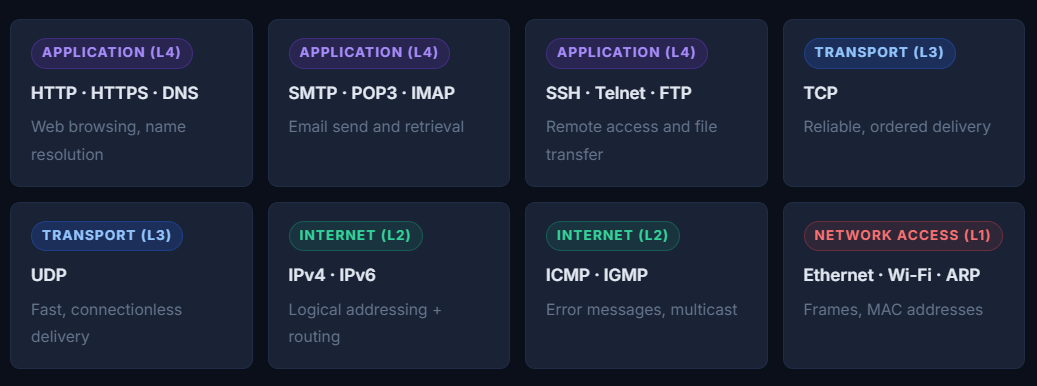
Real-world protocols mapped to their corresponding layers (TCP/IP model):
07 When to Use Which Model?
Troubleshooting network issues layer by layer ("Is this a Layer 2 or Layer 3 problem?"), studying for CCNA/Network+ certifications, designing vendor-neutral network architectures, or teaching networking concepts.
Writing socket-level code, configuring servers and firewalls, analysing Wireshark packet captures, working with real-world Internet protocols, or building networked applications.
In day-to-day networking, professionals say things like "that's a Layer 3 issue" (using OSI numbering) while the underlying protocol they're debugging is IP (TCP/IP). Both vocabularies coexist — and now you speak both.

Comments (0)
Leave a Comment
No comments yet. Be the first to comment!